Tag Archives: fitness

Aging Well — Mary M.

My father’s neighbor, Mary, celebrated her 99th birthday last month. She looks at least 20 years younger.

She still lives alone, in her own home. She gave up her high heels a couple of years ago after knee replacement surgery; and stopped driving because of cataracts.

On Christmas Eve, my father sent two of my sisters to Mary’s house to escort her across the street to a small Christmas Eve party he was having. He was worried about her walking in the dark on the icy pavement.  My sisters, who are in their 50s, said they had a hard time keeping up with Mary.

What keeps her “young”? (No, she doesn’t do yoga.) She remains physically active and mentally engaged. She goes to lunch with friends, gardens, plays bridge, has her hair done, bakes cakes for neighbors. She’s interested in people. Those may seem like small things, but they make an enormous difference in the quality of her life.

According to WebMd

  • Whether physically healthy or ill, people who feel connected to others are more likely to thrive than those who are socially isolated.
  • Challenging your intellect on a daily basis – reading, learning a new musical instrument or language, doing crossword puzzles, playing games of strategy with others – protects or improves memory and mental sharpness. Just like an active body, an active brain continues to develop and thrive, while an inactive brain loses its power over time.
Why Post-Holiday Fitness Resolutions Fail

By the end of January many of the holiday resolutions to exercise and become more fit will be broken.

Most people know that exercise is good for them. What gets in the way is emotions not determination.

Read about the Top Reasons Those “Get Fit” Resolutions Don’t Stick

Women may be more self-conscious than men about going to a gym. Women may feel more intimidated by the equipment, feel pressure to exercise in trendy clothes, and feel uncomfortable about exercising in front of the opposite sex.

I got some advice many years ago from a friend when I first started going to a coed gym. She told me that the men in the gym were far more interested in their bodies than they were in mine – and she was right.

And some other thoughts:

  • Avoid an all-or-nothing approach. Instead of committing to daily classes at the local gym, you might start by making smaller, incremental changes, such as taking the stairs or parking at the far-end of the parking lot.
  • If you really can’t find the time to exercise for an hour, break your exercise into more manageable (10-15 minute) chunks.
  • Small changes to diet can also add up to big weight loss.
  • And if you miss a day of exercise or break your diet, pick up where you left off. It’s not the end of the world.
  • If a big gym makes you uncomfortable, look for a specialty gym that caters to just woman or to your age group.
  • Or skip the gym and find an activity you really love – dancing, swimming, bicycling, walking….

National Institutes for Health (NIH) has several guides to help you choose a good mix of exercise activities which include strength-building, endurance, and balance.

For kids, fitness aids academic achievement

The research is out there – physically fit students do perform better academically!

New York City

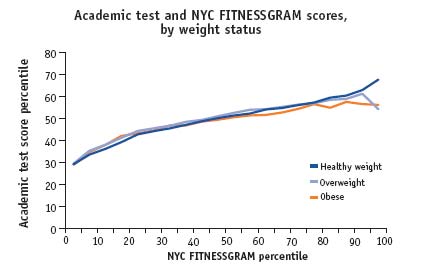
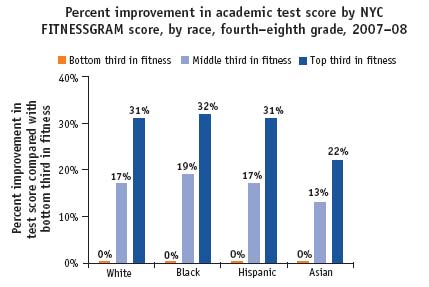
A report released in July by the New York City Health Department and Department of Education shows that physically fit students tend to outscore their peers who are less-fit on academic tests.

Test Scores

Test Score Improvement

Read the press release  or download the full report .

Texas

In March, a report by the Texas Education Agency  showed that physically fit students are more likely to do well in school and less likely to be disciplinary problems.

 Read the press release.

Exercise and the Brain

In his book,  Spark: The Revolutionary New Science of Exercise and the Brain, John Ratey, a Harvard clinical associate professor of psychiatry, argues for more physical fitness for students as a cure for not only their obesity but also their academic performance.

What Next…

For parents, teachers, school administrators, and legislators (and just about everyone else) the answer is clear. Part of the answer to increasing achievement test scores, school performance, and other measures is incorporating more physical activity into the lives of kids. The answer is not decreasing phys ed programs in order to spend time on academics. But it is not just more physical activity as part of the school curriculum. That increased activity must be part of their non-school lives as well.