One of the songs in a story on NPR on Sunday morning about the 50th anniversary of Earth Day, was Joni Mitchell’s Big Yellow Taxi.
Big Yellow Taxi — Joni Mitchell
Don’t it always seem to go That you don’t know what you’ve got Till it’s gone They paved paradise And put up a parking lot https://youtu.be/ZgMEPk6fvpg
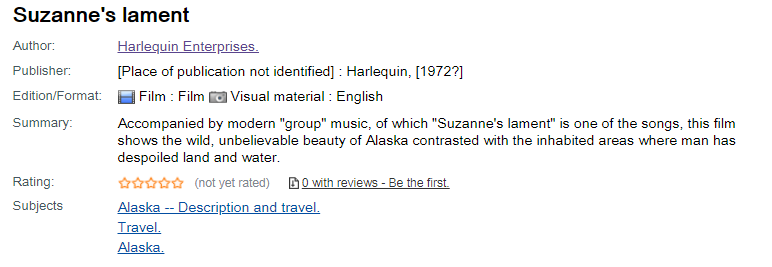
That got me thinking about other environmental protest songs. And that brought to mind an environmental film from the 70s called Suzanne’s Lament, which used the Leonard Cohen song as part of the soundtrack.
“…this film shows the wild, unbelievable beauty of Alaska contrasted with the inhabited areas where man has despoiled land and water.”
So I’m creating my own environmental playlist.
Suzanne — Leonard Cohen
Now, Suzanne takes your hand and she leads you to the river She’s wearing rags and feathers from Salvation Army counters And the sun pours down like honey on our lady of the harbor And she shows you where to look among the garbage and the flowers There are heroes in the seaweed, there are children in the morning They are leaning out for love and they will lean that way forever While Suzanne holds her mirror And you want to travel with her, and you want to travel blind And you know that you can trust her For she’s touched your perfect body with her mind https://youtu.be/RF3SJerPG7g
Paradise — John Prine
And daddy won’t you take me back to Muhlenberg County Down by the Green River where Paradise lay Well, I’m sorry my son, but you’re too late in asking, Mister Peabody’s coal train has hauled it away https://youtu.be/DEy6EuZp9IY
Pollution — Tom Lehrer
..if you visit American city you will find it very pretty just two things of which you must beware don’t drink the water and don’t breathe the air pollution, pollution we got smog and sewage and mud turn on your tap and get hot and cold running crud
Burn On — Randy Newman
There’s an oil barge winding Down the Cuyahoga River Rolling into Cleveland to the lake… Burn On Big River, Burn On https://youtu.be/6oUZzI0-a9I
Mercy Mercy Me (the Ecology) — Marvin Gaye
Oh mercy, mercy me Oh things ain’t what they used to be What about this overcrowded land How much more abuse from man can she stand? https://youtu.be/CShUISLYLGY
And a bit of hope…
Of Time And Rivers Flowing — Pete Seeger
Of time and rivers flowing The seasons make a song And we who live beside her Still try to sing along Of rivers, fish, and men And the season still a-coming When she’ll run clear again. The circles of the planets The circles of the moon The circles of the atoms All play a marching tune And we who would join in Can stand aside no longer Now let us all begin. https://youtu.be/zUrBHyWAxgE
Sailin’ Up, Sailin’ Down — Pete Seeger
Garbage here (garbage here), garbage there (garbage there) Here (there), there (here) – up and down the river Sailing on—stopping all along the way The river may be dirty now but it’s getting cleaner every day https://youtu.be/da8kcFEaoAI
Oh my aching back: Do yoga, tai chi or qigong help?
Researchers provide comprehensive review of effects of movement-based mind-body interventions on chronic low back pain
FLORIDA ATLANTIC UNIVERSITY
IMAGE: PEOPLE WITH CHRONIC LOW BACK PAIN ARE AT INCREASED RISK OF FUNCTIONAL LIMITATIONS, JOB-RELATED DISABILITY, AND POTENTIAL LONG-TERM DISABILITY. MOREOVER, THE ECONOMIC BURDEN OF CHRONIC LOW BACK PAIN IS HIGH… view more
CREDIT: FLORIDA ATLANTIC UNIVERSITY
It’s a pain. About 80 percent of adults in the United States will experience lower back pain at some point. Treating back pain typically involves medication, including opioids, surgery, therapy and self-care options. Efforts to reduce opioid use and increase physically based therapies to reduce pain and increase physical function and safety are crucial.
Patients are often advised to use non-pharmacological treatments to manage lower back pain such as exercise and mind-body interventions. But, do they really help? In a review published in the journal Holistic Nursing Practice, researchers from Florida Atlantic University’s College for Design and Social Inquiry and Christine E. Lynn College of Nursing evaluated the evidence of effects of three movement-based mind-body interventions on chronic low back pain. They examined yoga, tai chi, which combines gentle physical exercise and stretching with mindfulness, and qigong, a traditional Chinese meditative movement therapy focused on body awareness and attention during slow, relaxed, and fluid repetitive body movements. Little is known about the effects of movement-based mind-body intervention, in particular qigong and tai chi.
Researchers compared and contrasted yoga, tai chi and qigong by examining frequency and duration of these interventions; primary and secondary outcomes; attrition rates and possible adverse events; and results. Findings from their review provide empirical evidence regarding the benefits of yoga, tai chi, and qigong, which have been recommended by health care providers for patients with lower back pain.
“Back pain is a major public health issue often contributing to emotional distress such as depression and anxiety, as well as sleep issues and even social isolation,” said Juyoung Park, Ph.D., corresponding author and an associate professor in the Phyllis and Harvey Sandler School of Social Work within FAU’s College for Design and Social Inquiry. “We reviewed data to determine the effects of movement-based mind-body interventions on chronic back pain, psychological factors, coping strategies, and quality of life in people suffering with back pain. Our goal was to provide a comprehensive assessment of the effects of these interventions to be able to offer information across disciplines to implement evidence-based interventions to reduce such pain.”
Of the 625 peer-reviewed articles the researchers identified, 32 met inclusion criteria and were included in the review. Results found that the majority of these articles showed movement-based mind-body interventions to be effective for treatment of low back pain, reporting positive outcomes such as reduction in pain or psychological distress such as depression and anxiety, reduction in pain-related disability, and improved functional ability. Among the key findings, researchers discovered that longer duration and high-dose yoga intervention showed reductions in back pain while tai chi reduced acute lower back pain in males in their 20s. Tai chi also was more effective than stretching for lower back pain in young males. In the general community, tai chi showed greater reductions in pain intensity, bothersomeness of pain symptoms, and pain-related disability than the control intervention. Because there are only three qigong studies to date, it was unclear to the researchers whether this intervention is useful in treating chronic lower back pain. Existing research suggests positive benefits of yoga, however, tai chi and qigong for lower back pain are still under-investigated.
“Two of the studies we examined in our review were focused on the effects of movement modality, specifically yoga, in veterans. Many military veterans and active duty military personnel experience chronic low back pain and are affected by this pain more than the general population,” said Cheryl Krause-Parello, Ph.D., co-author, a professor and director of Canines Providing Assistance to Wounded Warriors (C-P.A.W.W.) within FAU’s Christine E. Lynn College of Nursing, and a faculty fellow of FAU’s Institute for Human Health and Disease Intervention (I-HEALTH). “Our review provides emerging evidence that movement-based mind-body interventions could benefit veterans and others experiencing chronic low back pain.”
The review included both randomized and nonrandomized studies with a total of 3,484 subjects ages 33 to 73 years old. Study sample sizes ranged from 25 to 320 subjects. The majority of articles reported on yoga (25), followed by tai chi (four), and qigong (three). Most of the yoga studies were conducted in India, followed by the U.S., while other studies were conducted in Australia (tai chi) and Germany (qigong).
People with chronic low back pain are at increased risk of functional limitations, job-related disability, and potential long-term disability. Moreover, the economic burden of chronic low back pain is high due to the cost of medications such as opioids, procedures, hospitalization, surgical treatment, and absence from work.
“Yoga, tai chi and qigong could be used as effective treatment alternatives to pain medications, surgery, or injection-based treatments such as nerve blocks, which are associated with high incidence of adverse effects in treating lower back pain,” said Park. “We need more clinical trials and empirical evidence so that clinicians can prescribe these types of interventions with more confidence for managing lower back pain in their patients.”
###
Co-author of the study is Chrisanne M. Barnes, M.S., a former master’s student of Krause-Parello.
About Florida Atlantic University:
Florida Atlantic University, established in 1961, officially opened its doors in 1964 as the fifth public university in Florida. Today, the University, with an annual economic impact of $6.3 billion, serves more than 30,000 undergraduate and graduate students at sites throughout its six-county service region in southeast Florida. FAU’s world-class teaching and research faculty serves students through 10 colleges: the Dorothy F. Schmidt College of Arts and Letters, the College of Business, the College for Design and Social Inquiry, the College of Education, the College of Engineering and Computer Science, the Graduate College, the Harriet L. Wilkes Honors College, the Charles E. Schmidt College of Medicine, the Christine E. Lynn College of Nursing and the Charles E. Schmidt College of Science. FAU is ranked as a High Research Activity institution by the Carnegie Foundation for the Advancement of Teaching. The University is placing special focus on the rapid development of critical areas that form the basis of its strategic plan: Healthy aging, biotech, coastal and marine issues, neuroscience, regenerative medicine, informatics, lifespan and the environment. These areas provide opportunities for faculty and students to build upon FAU’s existing strengths in research and scholarship. For more information, visit fau.edu.



 The Yoga Librarian